
7 Best Rock Wool Sandwich Panels for Global Buyers
Choosing the right rock wool sandwich panel is not simply a matter of comparing prices. Global buyers must examine fire performance, thermal resistance, acoustic control, moisture behavior, and installation conditions.
A panel that performs well in a cold warehouse may disappoint in a humid coastal factory. Core density matters. Joint design matters. Even the installer’s handling can affect long-term performance. ROCKWOOL Group’s former CEO Jens Birgersson captured the wider principle: “Stone wool is a material for the future.” That view is relevant, but it should not replace technical verification.
This guide reviews seven strong rock wool sandwich panel options for international projects. The selection considers insulated walls, roofs, cleanrooms, cold storage, industrial facilities, and modular buildings. Each option should be checked against local fire codes, declared U-values, panel thickness, coating durability, and available certification.
Details matter.
For example, a 100 mm panel may suit a standard factory wall, while a thicker system could better support severe winter conditions. Exposed edges, poorly sealed fasteners, and damaged metal skins can create weak points. These problems are easy to overlook during purchasing.
No ranking is perfect. Product availability changes by region, and specifications may differ between manufacturers. Buyers should request current datasheets, test reports, warranty terms, and sample sections before ordering. A practical comparison is more reliable than a glossy brochure.
The best panel is not always the cheapest or the thickest. It is the system that matches the building’s risks, climate, fire strategy, and construction skills. That requires careful questions, not assumptions.
What Rock Wool Sandwich Panels Are and How They Work
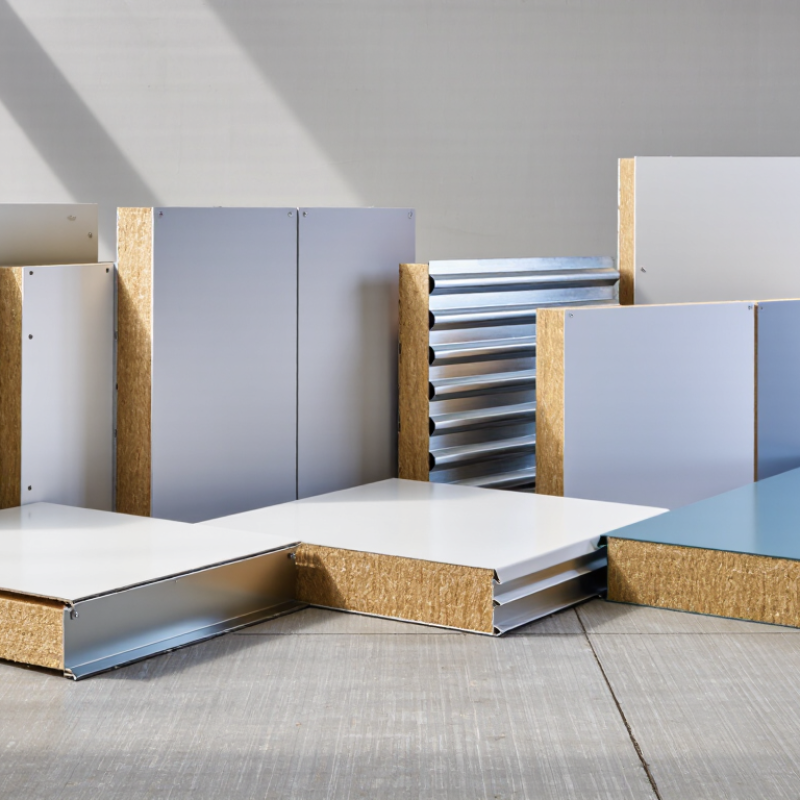
Rock wool sandwich panels combine two protective metal sheets with a dense mineral wool core. The core is made from spun rock fibers, arranged to trap air and slow heat movement. This structure gives the panel useful thermal resistance without making the wall excessively thick.
The outer sheets provide strength and protect the insulation from impact. They also help transfer wind loads across the panel surface. Inside, the rock wool reduces heat conduction and limits air movement. Its fibrous texture can also absorb sound, which helps control noise in workshops, warehouses, and industrial rooms. Rock wool is generally non-combustible, but the complete fire rating depends on thickness, joints, coatings, supports, and testing.
The joints matter greatly. A well-insulated panel can perform poorly when seams are open or fasteners are incorrectly placed. On real projects, installers should check panel alignment, sealant continuity, moisture exposure, and the condition of cut edges. Small gaps can create cold bridges. They may also allow water to enter.
A panel is not a magic shield. Its performance depends on the whole wall system, not the core alone. Specifications may look strong on paper, yet poor installation can reduce comfort, durability, and fire performance. Regular inspections remain worthwhile, especially around corners, roof connections, and door openings.
Key Performance Criteria for Selecting a Rock Wool Sandwich Panel
Selecting a rock wool sandwich panel requires more than comparing price and thickness. Thermal performance should be checked through declared U-value, thermal conductivity, and joint design. The International Energy Agency reports that buildings consume about 30% of global final energy. Poorly sealed panel joints can weaken real-world efficiency, even when laboratory results look excellent.
Fire performance deserves equal attention. Choose panels tested under recognized standards, such as EN 13501-1 or equivalent local requirements. Some mineral wool systems can achieve non-combustible classifications, but the complete assembly still matters. Core density, facings, fasteners, and installation details can change the result. Do not rely on a single certificate. Ask for test scope, thickness, ageing conditions, and production-batch traceability.
Tips: Request thermal, fire, acoustic, and corrosion data in one technical file. Check whether the declared value covers the exact thickness you need. The U.S. Department of Energy notes that insulation performance depends heavily on installation quality. That detail is easy to overlook.
In practice, I would inspect panel edges, compression marks, and visible gaps before approving delivery. A lower U-value is not automatically better if water enters the joint. This is where many specifications become too optimistic. Also review acoustic data carefully: laboratory sound absorption results may not represent a busy factory or refrigerated warehouse. Ask for tested performance, not vague claims such as “excellent insulation.”
Seven Leading Rock Wool Sandwich Panel Types for Global Buyers
Seven leading rock wool sandwich panel types serve different building needs, climates, and installation conditions.
Standard wall panels suit warehouses, workshops, and agricultural buildings.
Fire-rated panels use non-combustible mineral wool cores and tested joint systems.
Their performance depends on the complete assembly, not the core alone.
Acoustic panels reduce reverberation in factories, studios, and machinery rooms.
Perforated inner facings can improve sound absorption.
Cold-room panels provide thermal resistance for chilled storage and food facilities.
They need carefully sealed joints. Small gaps can create condensation problems.
Cleanroom panels offer smooth, washable surfaces for controlled production areas.
Roof panels combine insulation, weather resistance, and structural support. Engineers should check snow loads, wind pressure, drainage, and fixing patterns.
Facade panels provide a durable exterior envelope with a more architectural appearance.
They often require closer attention to color, movement, and water detailing.
On practical projects, installers commonly focus on edge damage, panel alignment, and fastener torque.
These details look minor, but they affect airtightness and service life.
Buyers should request declared thermal conductivity, fire classification, acoustic data, and corrosion information.
Requirements vary by country and building type, so local standards must guide approval.
No single panel type fits every project.
A lower-cost choice may become expensive after repairs.
That deserves reflection.
Comparing Fire Safety, Thermal Insulation, and Acoustic Performance
7 Best Rock Wool Sandwich Panels for Global Buyers
Comparing Fire Safety, Thermal Insulation, and Acoustic Performance
For global buyers, rock wool sandwich panels should be judged beyond thickness and price. Fire resistance is the first serious filter. Under EN 13501-1, non-combustible mineral wool cores can achieve Class A1 when the complete tested assembly qualifies. However, core performance alone is not enough. Joints, fasteners, coatings, and penetrations can change the result. That detail is often ignored.
Thermal performance depends on density, moisture, panel thickness, and installation quality. Typical rock wool cores report thermal conductivity near 0.035–0.045 W/m·K. The IEA Buildings 2023 report states that buildings consume about 30% of global final energy. Better envelope design can reduce heating and cooling demand, but advertised U-values should be checked against EN 14509 or equivalent testing. A small gap at the joint can undermine an impressive laboratory figure.
Acoustic performance is more complicated than a single decibel number. ISO 10140 laboratory testing measures airborne sound insulation, while site results may fall because of flanking paths and imperfect sealing. Rock wool panels can provide useful absorption in industrial halls, workshops, and logistics buildings. Yet absorption is not the same as sound isolation. Buyers should request tested Rw or STC values, frequency curves, and installation details. Seven panels may appear similar on paper. They rarely perform identically in real buildings.
| Panel Type | Typical Core Thickness | Nominal Core Density | Thermal Conductivity (λD) | Typical U-Value Range* | Fire Safety | Acoustic Performance | Recommended Use | Key Trade-Off |
|---|---|---|---|---|---|---|---|---|
| 1. Standard Exterior Wall Panel | 50–100 mm | 90–120 kg/m³ | 0.038–0.043 W/m·K | 0.38–0.75 W/m²·K | A1 core reaction to fire is commonly achievable; tested panel fire resistance depends on the complete assembly. | Approx. Rw 28–36 dB, subject to joint design and facings | Warehouses, workshops, agricultural buildings, and general industrial façades | Good balance of cost, fire safety, and installation speed; limited performance at very low temperatures compared with thicker panels. |
| 2. High-Fire-Resistance Wall Panel | 100–200 mm | 100–150 kg/m³ | 0.038–0.044 W/m·K | 0.20–0.38 W/m²·K | Designed for tested fire-resistance classifications such as EI 60–EI 120, depending on thickness, joints, spans, and fixing system. | Approx. Rw 32–42 dB | Factories, logistics centers, data-related buildings, and compartment walls | Higher weight and material cost; the required fire rating must be verified using a complete tested system. |
| 3. Cold-Store and Temperature-Controlled Wall Panel | 120–200 mm | 100–140 kg/m³ | 0.037–0.043 W/m·K | 0.19–0.32 W/m²·K | Non-combustible mineral-wool core options are available; vapor control and fire performance depend on the panel construction. | Approx. Rw 34–43 dB | Food processing, chilled distribution, temperature-controlled storage, and clean production areas | Excellent thermal stability, but airtight joints, thermal bridges, and condensation control require careful detailing. |
| 4. High-Acoustic Wall Panel | 80–150 mm | 100–150 kg/m³ | 0.039–0.045 W/m·K | 0.26–0.50 W/m²·K | Mineral-wool cores are generally suitable for high fire-safety designs; tested fire classification varies by facing and joint system. | Approx. Rw 38–48 dB; perforated or micro-perforated facings may improve sound absorption | Plant rooms, manufacturing halls, workshops, music-related spaces, and noisy enclosures | Better noise control than standard panels, but acoustic results are highly affected by doors, penetrations, seals, and reverberation. |
| 5. Roof Sandwich Panel with Rock Wool Core | 80–200 mm | 100–150 kg/m³ | 0.038–0.044 W/m·K | 0.20–0.50 W/m²·K | A1 mineral-wool core options are common; roof fire classification must be confirmed for the complete roof build-up. | Approx. Rw 30–40 dB, depending on profile, thickness, and ceiling construction | Industrial roofs, commercial buildings, warehouses, and production facilities | Strong fire and weather performance; structural span, drainage, fasteners, and wind loading must be checked for each project. |
| 6. Cleanroom and Hygienic Panel | 50–150 mm | 90–140 kg/m³ | 0.038–0.043 W/m·K | 0.26–0.75 W/m²·K | Fire performance can be based on a non-combustible rock-wool core; surface coatings and sealed joints influence the tested classification. | Approx. Rw 30–40 dB | Pharmaceutical, food, medical, laboratory, and controlled-environment interiors | Smooth, washable surfaces and sealed joints support hygiene requirements, but specialist detailing increases project cost. |
| 7. High-Impact and Heavy-Duty Industrial Panel | 100–200 mm | 120–180 kg/m³ | 0.039–0.045 W/m·K | 0.20–0.40 W/m²·K | High-density rock-wool cores can support robust fire designs; the final rating requires assembly testing and approved installation details. | Approx. Rw 35–45 dB | Heavy manufacturing, power facilities, transport buildings, and high-traffic industrial areas | Improved durability, rigidity, and sound reduction, with greater panel weight and higher lifting requirements. |
| Technical note: The values shown are representative design ranges for rock-wool sandwich panels and are not product certifications. Actual U-values depend on panel thickness, steel facings, thermal bridges, joints, fasteners, and installation quality. Fire classifications should be verified under the applicable project standard, such as EN 13501-1, EN 13501-2, ASTM E119, or equivalent local requirements. Acoustic ratings should be confirmed through laboratory or project-specific testing. | ||||||||
Installation, Certification, and International Purchasing Considerations
7 Best Rock Wool Sandwich Panels for Global Buyers
Selecting rock wool sandwich panels requires more than comparing thickness and price. The seven strongest options usually serve walls, roofs, cold rooms, fire-rated partitions, clean areas, acoustic spaces, and industrial buildings. Each application needs a different density, facing, joint design, and load rating. A 100 mm panel may perform well on a wall but fail to meet a roof’s span requirements. Check technical drawings, fire performance, thermal conductivity, and acoustic data before ordering.
Installation quality affects the panel’s real performance. Store panels under cover, keep them off wet ground, and protect cut edges. Install fasteners according to the structural design, not guesswork. Tight joints reduce air leakage and moisture entry. Flashings must overlap correctly around doors, corners, and roof penetrations. Small gaps are expensive later. I have found that rushed alignment often creates visible waves across long elevations.
Certification should match the destination market and building use. Request current fire-test reports, product declarations, factory quality records, and loading tables. Common references may include EN 13501-1 or ASTM-based testing, but acceptance depends on local authorities. For international purchasing, confirm dimensions, tolerances, surface coatings, packaging, lead time, Incoterms, and customs documents. Agree on inspection procedures before production begins. A pre-shipment check can verify panel thickness, joint fit, coating condition, and labeling. It is not perfect, but it prevents avoidable surprises.
