| Product Selection |
Primary material |
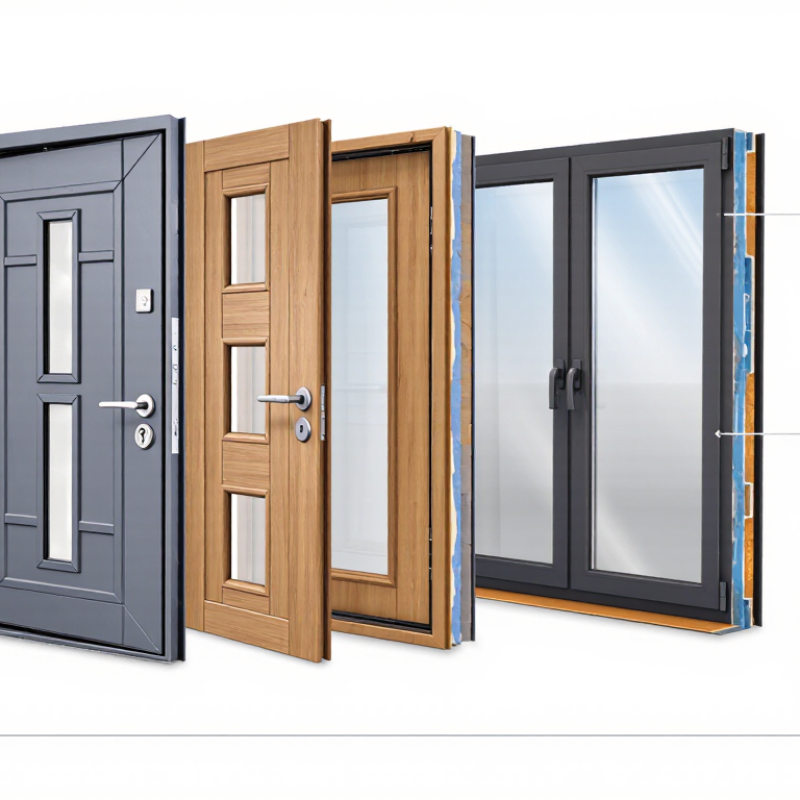
Fiberglass, thermally broken aluminum, uPVC, engineered wood, or solid timber |
Fiberglass and uPVC generally offer low maintenance. Thermally broken aluminum provides strength and slim sightlines. Timber requires more regular coating maintenance. |
| Product Selection |
Window glazing |
Double glazing for moderate climates; triple glazing for cold climates or high energy-efficiency targets |
Confirm the spacer type, gas fill, low-emissivity coating, glass thickness, and safety-glass requirements before ordering. |
| Product Selection |
Entry-door core |
Insulated foam core for exterior doors; solid engineered construction where impact resistance or security is prioritized |
The door slab, frame, sill, weatherstripping, and threshold should be evaluated as one complete weather-resistant assembly. |
| Thermal Performance |
Window U-factor |
Approximately 0.20–0.40 Btu/h·ft²·°F (1.14–2.27 W/m²·K); lower values indicate better insulation |
Compare products using the same test method and whole-window values rather than center-of-glass values alone. Local energy codes may require different limits. |
| Thermal Performance |
Exterior door U-factor |
Approximately 0.13–0.30 Btu/h·ft²·°F (0.74–1.70 W/m²·K); lower values indicate better insulation |
Ask whether the stated value applies to the complete door set, including the frame, glazing, sill, and threshold. |
| Thermal Performance |
Solar Heat Gain Coefficient |
About 0.25–0.45 for many energy-conscious window applications |
Lower SHGC can reduce unwanted heat gain in hot climates. A higher value may be useful in cold climates with beneficial winter solar exposure. |
| Thermal Performance |
Air leakage |
Prefer tested values at or below 0.30 cubic feet per minute per square foot at 1.57 psf, where the applicable standard uses this rating |
Lower air leakage usually improves comfort and energy performance. Confirm the test standard because rating systems differ by market. |
| Weather Resistance |
Water penetration test |
Performance should be verified at a pressure suitable for the project exposure; common test pressures include 15, 20, or 30 psf |
Coastal, hurricane-prone, high-rise, and highly exposed locations may require substantially higher tested performance and local certification. |
| Weather Resistance |
Wind-load design |
Project-specific design pressure based on building height, location, terrain, opening size, and local code |
Do not select a window or door from wind speed alone. A qualified local professional should confirm design pressure and anchorage requirements. |
| Safety |
Safety glazing |
Tempered or laminated safety glass where required by local code, including many doors, sidelites, low-level panes, and wet-area locations |
Glass safety requirements vary by jurisdiction. Request permanent safety markings and compliance documentation when applicable. |
| Security |
Hardware and locking points |
Multipoint locking for many exterior doors; corrosion-resistant hardware for humid, coastal, or industrial environments |
Confirm cylinder format, keying requirements, emergency egress needs, handle height, and compatibility with local security systems. |
| Accessibility |
Threshold and clear opening |
Use a low-profile, weather-resistant threshold and a clear opening sized for the intended users and local accessibility rules |
The nominal door size is not the same as the clear passage. Check finished-floor levels, threshold height, swing direction, and maneuvering space. |
| Sizing |
Measurement method |
Measure width, height, depth, squareness, plumb, level, and diagonal dimensions at several points |
For replacement work, measure the existing opening after removing trim where possible. For new construction, coordinate the rough opening with the wall system and flashing design. |
| Sizing |
Manufacturing tolerance |
Allow a project-specific installation gap; the exact allowance depends on product design, opening size, and installation method |
Do not apply one universal gap to every product. Obtain the supplier's approved rough-opening and shim instructions before production. |
| Standards |
Compliance documentation |
Request product drawings, test reports, installation instructions, material declarations, warranty terms, and applicable conformity documents |
Standards and approvals differ between countries and regions. Verify requirements with the local building authority, architect, or engineer before purchase. |
| Ordering |
Configuration details |
Opening size, handing, swing direction, frame depth, glazing, color, hardware, screens, grilles, sill, and drainage configuration |
A signed shop drawing should show all critical dimensions and accessories. Changes after production may be costly or impossible. |
| Ordering |
Color and finish |
Powder-coated or anodized aluminum, factory-finished uPVC, fiberglass coating, or exterior wood coating |
Confirm color reference, gloss level, coating warranty, batch consistency, and whether dark colors are suitable for the project's solar exposure. |
| Shipping |
Export packaging |
Moisture-resistant wrapping, corner protection, separators, edge guards, and secured pallets or export crates |
Packaging should prevent movement, abrasion, glass contact, and trapped moisture. Request packaging photographs before dispatch for large orders. |
| Shipping |
Container planning |
A standard 20-foot dry container has an internal length of approximately 5.9 m; a 40-foot dry container is approximately 12.0 m, with internal width near 2.35 m |
Actual usable space depends on door size, crate dimensions, stacking limits, weight distribution, and carrier restrictions. Final loading should use a packing plan. |
| Shipping |
Glass and product weight |
Glass weighs approximately 2.5 kg per square metre per millimetre of thickness; a 6 mm single pane weighs about 15 kg/m² |
Calculate total unit weight before shipping and installation. Large glazed units may require lifting equipment and specialist handling. |
| Shipping |
Incoterms and insurance |
Agree the delivery term, named place, risk transfer point, cargo insurance responsibility, and customs responsibilities in writing |
The buyer should understand who arranges export clearance, ocean freight, import clearance, inland delivery, unloading, duties, and taxes. |
| Shipping |
Pre-dispatch inspection |
Check quantities, dimensions, labels, glass condition, hardware, finish, accessories, and packaging against the approved order |
Photograph the products and packing condition before loading. Record serial or package references where available. |
| Receiving |
Delivery inspection |
Inspect cartons, crates, frames, glass, hardware, and visible finishes immediately upon delivery |
Note shortages or damage on the carrier's delivery record and notify the responsible party promptly according to the purchase terms. |
| Storage |
On-site storage |
Keep units upright, supported, dry, ventilated, shaded, and separated from concrete, chemicals, and construction debris |
Do not store sealed products flat unless the manufacturer's instructions specifically allow it. Protect glass from impact and prolonged direct sun during storage. |
| Installation |
Installation sequence |
Prepare opening, install sill support and flashing, set and shim unit, fasten, insulate, seal, operate, and finish interior and exterior interfaces |
The installation must manage water, air, vapor, and thermal continuity. Follow the approved product instructions and local construction practice. |
| Installation |
Flashing and drainage |
Use a sloped sill, end dams where required, compatible flashing, and an exterior sealant joint that allows drainage |
Do not block weep holes or drainage paths. Sealant compatibility should be checked with the frame, flashing, coating, and adjacent materials. |
| Installation |
Fastening |
Use corrosion-resistant fasteners suitable for the frame, substrate, loads, and exposure; spacing must follow the tested installation design |
Over-tightening can distort frames and affect operation. Anchorage should transfer wind and operational loads into the structure. |
| Installation |
Insulating the perimeter |
Use a compatible low-expansion insulating material or approved backer system without bowing the frame |
An uninsulated perimeter can create drafts and condensation. Protect foam and seal the interior and exterior air-control layers as designed. |
| Installation |
Operational testing |
Verify smooth opening, closing, locking, drainage, gasket contact, and glass condition before handover |
Record alignment or hardware adjustments at completion. Do not force a unit that is out of square or incorrectly supported. |
| Maintenance |
Routine cleaning |
Clean glass and frames with clean water, mild detergent, and a soft cloth; rinse and dry thoroughly |
Avoid abrasive pads, strong solvents, metal scrapers, and unapproved chemicals that may damage coatings, seals, or finishes. |
| Maintenance |
Inspection frequency |
Inspect at least annually; inspect more frequently in coastal, high-pollution, high-wind, or heavily used locations |
Check sealant joints, gaskets, fasteners, drainage openings, corrosion, coating condition, condensation signs, and hardware operation. |
| Maintenance |
Hardware lubrication |
Lubricate moving hardware with the lubricant specified by the product instructions, commonly once or twice per year |
Remove dirt before lubrication. Avoid products that attract dust or attack rubber, plastic, painted, or coated surfaces. |
| Maintenance |
Sealant and gasket renewal |
Repair failed sealant, loose gaskets, or damaged weatherstripping when deterioration is observed |
Use compatible replacement materials and preserve designed drainage paths. Persistent leakage may indicate an installation or structural problem, not only failed sealant. |
| Climate Suitability |
Cold or heating-dominated climate |
Prioritize low U-factor, insulated frames, warm-edge spacers, airtight installation, and condensation-resistant details |
Indoor humidity control is also important. Condensation can result from high humidity, thermal bridges, poor ventilation, or inadequate product performance. |
| Climate Suitability |
Hot or cooling-dominated climate |
Prioritize suitable SHGC, solar control glazing, external shading, low air leakage, and durable UV-resistant finishes |
Orientation matters. West- and south-facing openings may require stronger solar-control measures depending on latitude and local climate. |
| Climate Suitability |
Coastal or humid climate |
Use corrosion-resistant hardware, properly specified coatings, durable sealants, laminated options where appropriate, and effective drainage |
Salt exposure accelerates corrosion. Cleaning intervals and inspection frequency should be increased near the sea or in locations with airborne contaminants. |
| Warranty |
Warranty scope |
Confirm separate coverage periods for frames, insulated glass, hardware, finish, screens, installation, and labor |
Check exclusions for improper storage, unsuitable cleaning chemicals, coastal exposure, unauthorized modifications, condensation, and installation by unapproved contractors. |
| Total Cost |
Landed-cost components |
Product price, packaging, inland transport, export fees, freight, insurance, customs clearance, duties, taxes, local delivery, unloading, installation, and maintenance |
Compare complete landed cost rather than factory price alone. Include contingency for damage, storage, handling equipment, and site modifications. |