2026 Top Cleanroom Dehumidifier Types for Global Buyers
In 2026, global buyers will evaluate Cleanroom Dehumidifier systems beyond simple moisture removal. Stable humidity protects sterile packaging, sensitive sensors, pharmaceutical powders, and precision coatings. It also supports cleaner airflow and more predictable production results.
Cleanroom researcher Dr. William Whyte has said that a cleanroom is “a system, not simply a room.” This principle matters when selecting equipment. A desiccant dehumidifier can achieve very low dew points in pharmaceutical and electronics facilities. Refrigerant models may suit less demanding spaces with moderate humidity loads. Hybrid systems can balance energy use, recovery speed, and seasonal conditions. The right choice depends on process heat, air-change rates, room pressure, and local climate.
Small details matter.
A buyer should inspect rotor materials, filtration stages, controls, maintenance access, and sensor accuracy. In coastal regions, salty outdoor air can increase corrosion risks. In cold climates, heating demand may become unexpectedly high. These issues are easy to underestimate during a specification review.
Not every advertised efficiency figure reflects real operation. That deserves scrutiny. Field experience shows that poor duct design, oversized capacity, or weak commissioning can reduce performance quickly. A technically impressive unit may still waste energy if it cannot respond to changing production loads. This guide compares the leading Cleanroom Dehumidifier types for global buyers, while recognizing that no single design fits every facility. Reliable decisions require measured data, qualified engineering review, and honest attention to operating limitations.
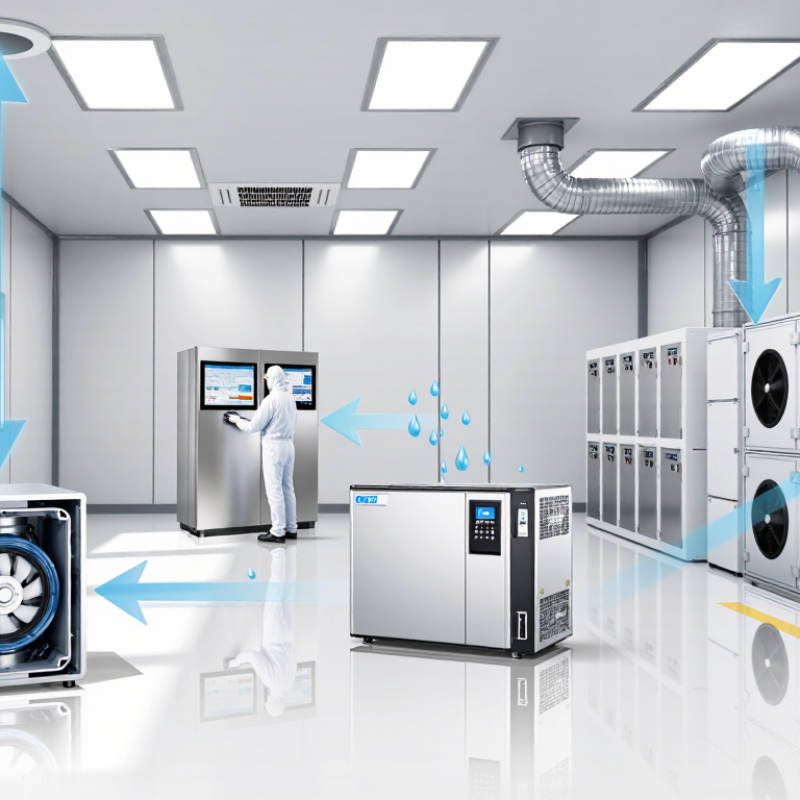
Cleanroom Dehumidifier Basics and Moisture-Control Requirements
2026 Top Cleanroom Dehumidifier Types for Global Buyers
Cleanroom Dehumidifier Basics and Moisture-Control Requirements
Cleanroom dehumidifiers protect sensitive processes from condensation, corrosion, and unstable product conditions. The right system depends on room classification, temperature, humidity range, and required dew point. Desiccant dehumidifiers suit areas requiring very dry air, especially below 30% relative humidity. Refrigerant units can work well in warmer spaces with moderate moisture loads. Hybrid systems may offer better control when conditions change throughout the year.
A reliable selection begins with measured data, not a catalogue promise. Record outdoor humidity, process heat, door openings, and air-change rates. A small cleanroom can still have a heavy moisture load. People, wet materials, and cleaning procedures often create hidden peaks. Filtration, airflow pattern, and heat recovery also affect performance. Poorly positioned air outlets may create damp corners, even when the control panel shows acceptable humidity. I have seen designs fail because average conditions replaced real operating conditions. That mistake deserves review.
Tips: Set alarms for high humidity and low dew point. Verify sensors with scheduled calibration. Keep coils, filters, and desiccant components accessible for maintenance. Test the room after cleaning and during peak occupancy. Do not size equipment from floor area alone; use a documented moisture-load calculation. Over-drying can increase energy use and create material issues, so define the acceptable humidity window with process engineers.
Key Dehumidifier Types Used in Modern Cleanrooms
2026 Top Cleanroom Dehumidifier Types for Global Buyers
Modern cleanrooms commonly use desiccant, refrigerant, heat-pump, and hybrid dehumidifiers. Each type controls moisture differently.
Desiccant units use silica gel or similar materials to capture vapor. They perform well when rooms require low dew points, especially below 10°C. ASHRAE Handbook—HVAC Systems and Equipment (2024) identifies desiccant systems as suitable for low-humidity applications and moisture-sensitive manufacturing. They also support stable conditions during frequent air changes. However, regeneration heat can increase energy use. That cost is easy to underestimate.
Refrigerant dehumidifiers cool air below its dew point, then reheat it. They suit moderate humidity loads and warmer cleanroom environments. Heat-pump versions can recover useful heat and reduce reheat demand. Hybrid systems combine cooling coils with desiccant wheels, offering better control during seasonal changes. The U.S. Department of Energy reports that HVAC can represent around 40% of energy use in commercial buildings, making efficiency a practical purchasing concern. ISO 14644-1 classifies airborne particle cleanliness, but it does not select the dehumidifier type. Buyers must match dew point, airflow, pressure balance, filtration, and validation needs. A quieter unit is not automatically a better unit. Performance can change after filter loading, door openings, or maintenance delays. Review operating data, not only catalogue ratings.
2026 Top Cleanroom Dehumidifier Types for Global Buyers
Typical leaving-air dew-point ranges by dehumidification technology used in modern cleanrooms. Lower dew points support moisture-sensitive processes, while the actual result depends on airflow, regeneration temperature, insulation, and system design.
How to read the chart: Refrigerant systems are generally suited to moderate humidity loads. Desiccant rotor and hybrid systems can achieve much lower dew points for pharmaceutical, battery, electronics, and other moisture-sensitive cleanroom applications. Liquid desiccant systems are commonly used for moderate moisture control and heat-sensitive processes.
How Each Cleanroom Dehumidifier Type Works
Cleanroom dehumidifiers control moisture before it harms processes, materials, or product stability. Their working principle differs by room temperature, humidity load, and cleanliness target.
Desiccant rotor units pass humid air through a rotating wheel coated with moisture-adsorbing material. The wheel captures water vapor, then moves through a warm regeneration zone. Heated air removes the stored moisture and exhausts it outside. This design performs well below 10°C and can reach very low dew points. It also consumes substantial regeneration energy. Operators should inspect seals, filters, and wheel speed regularly. Small air leaks can reduce performance quickly.
Refrigerant dehumidifiers cool air below its dew point. Water condenses on a cold coil, drains into a controlled system, and drier air returns to the cleanroom. They suit moderate humidity loads and warmer spaces. However, their capacity drops when room temperatures fall. Coil cleanliness matters. A thin dust layer can reduce heat transfer and create unstable humidity readings.
Membrane systems use selective materials to separate water vapor from compressed air or process air. They have few moving parts and can respond quickly to localized drying needs. Yet, they may require clean, dry compressed air and careful flow control. Hybrid systems combine cooling and desiccant stages when one method cannot handle changing loads. That sounds efficient, but controls become more complex. Real commissioning data should guide the final selection, not a catalogue rating alone.
Selecting the Right Dehumidifier for Global Cleanroom Applications
2026 Top Cleanroom Dehumidifier Types for Global Buyers
Selecting the Right Dehumidifier for Global Cleanroom Applications
Cleanroom dehumidification begins with process needs, not catalog capacity. Desiccant dehumidifiers suit pharmaceutical and electronics rooms requiring very low dew points. Refrigerant units work well in warmer spaces with moderate moisture loads. Hybrid systems can reduce energy use when conditions change throughout the day.
The global dehumidifier market was valued at about USD 4.1 billion in 2023, according to MarketsandMarkets, with continued growth expected through 2028. That growth reflects wider demand for controlled manufacturing environments. However, market growth does not guarantee the correct selection. A 20,000-square-foot cleanroom may need different airflow control than a smaller sterile filling suite.
Start with the required dew point, air-change rate, room pressure, and contamination-control strategy. ISO 14644-1 classifies airborne cleanliness by particle concentration, but it does not define every humidity target. Facility engineers must connect humidity limits with product sensitivity and local climate data. Coastal sites may face persistent moisture. High-altitude sites may require different fan and coil calculations.
Check filter access, drain design, heat rejection, controls, and calibration records. Energy Star research shows that dehumidification efficiency depends strongly on operating conditions, not only rated capacity. That detail is often missed.
In field evaluations, oversized units can cycle poorly and create unstable humidity. A smaller, accurately controlled system may perform better. Sometimes, less equipment is the safer choice. Recheck the assumption.
Installation, Maintenance, and Performance Evaluation Criteria
2026 Top Cleanroom Dehumidifier Types for Global Buyers
Desiccant units suit low-dew-point processes, while DX and chilled-water systems fit moderate humidity loads. Selection should follow the process requirement, not catalog capacity. ISO 14644-1 classifies airborne particles, but it does not prescribe one universal humidity range. The validated product process must define temperature and dew point. ASHRAE Handbook—HVAC Applications (2023) stresses moisture-load calculation, outdoor-air control, and stable sensor placement.
Installation details decide real performance. Place the dehumidifier outside critical zones when possible, then use insulated ducts and sealed penetrations. Provide a visible condensate drain with proper slope. Avoid placing the humidity sensor beside supply air. A two-degree reading error can trigger unnecessary reheat. Commissioning should record dew point, room pressure, airflow, recovery time, and electrical demand under both idle and production loads.
Maintenance needs evidence, not assumptions. Inspect prefilters and coils monthly, check desiccant condition according to operating hours, and calibrate sensors at defined intervals. The U.S. Department of Energy reports that cleanrooms can consume 10–50 times more energy per floor area than ordinary commercial spaces. Efficiency therefore deserves measurement. Track kWh per 1,000 cubic feet per minute, pressure-drop trends, and reheat hours. A 2022 Lawrence Berkeley National Laboratory review also identifies airflow and conditioning as major cleanroom energy drivers. One weakness remains: laboratory efficiency may disappear after frequent door opening or production changes. Performance testing should reflect actual shifts, not an ideal empty room.